
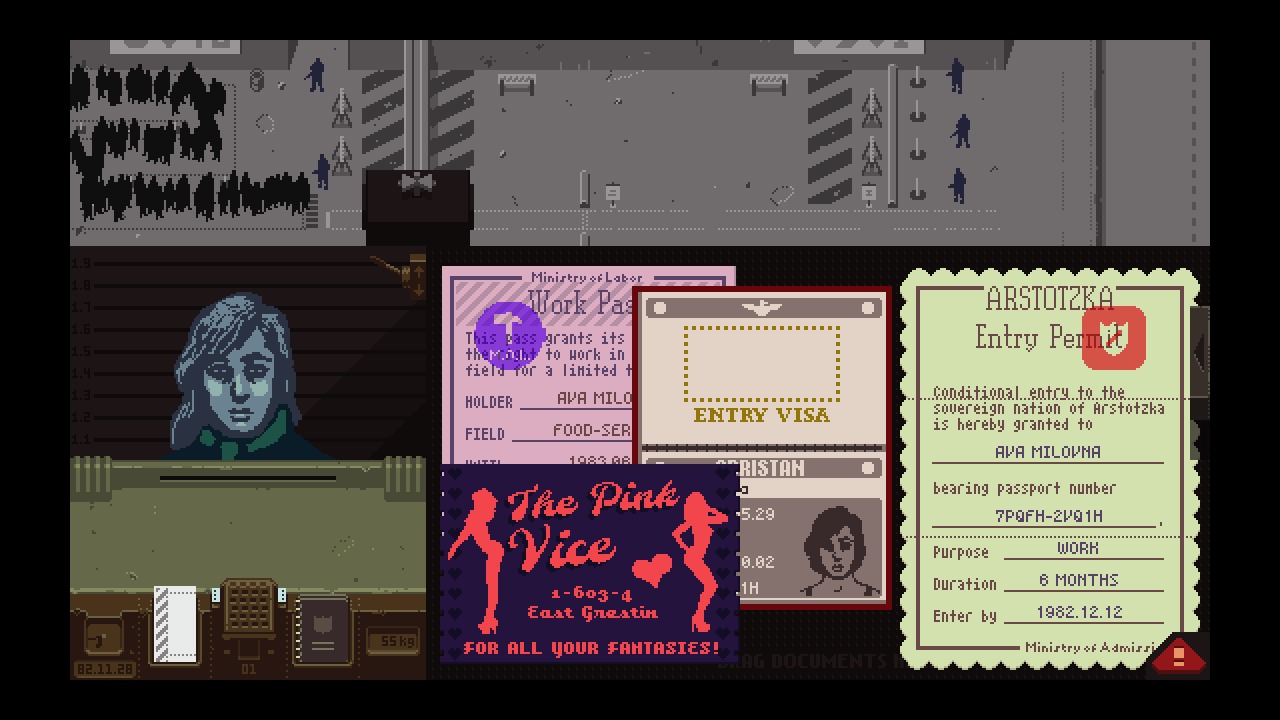
In Papers, Please, a guard named Sergiu Volda falls in love with a woman from Kolechia, Elisa Katsenja. The couple seeks to reunite in Arstotzka, but she lacks the required documents. Sergiu asks me, an officer working at the border, if I can let her pass the checkpoint, and I accept his request simply because I don’t want to add more frustration to this already gloomy world. However, shortly after Elisa leaves, the border is attacked by a group of militants, and I fail to neutralize them before Sergiu gets killed. Dominated by the desire to free the couple from devastation, I choose to restart from the beginning of the day. As one passport after another is stamped, my proficiency in marksmanship is also improving, until it becomes an easy feat to save him by taking down the aggressors with quick reaction and good precision.
Repetition in games is based on the existence of certainty. My effort as a player rests on the belief that the character can be rescued, thus having a favorable outcome as a result. After replaying enough times, a player can achieve, or at least infinitely approximate, a state of perfection. This “practice makes perfect” logic is then rewarded with clear and tangible feedback. Even if the process turns unbearably exhausting, I can always quit the game as a last resort. With these conditions in place, repetition at play is essentially a reassuring experience, rather than a disorienting ordeal.
Compared with virtual spaces, repetition in the real world often appears more illogical, sometimes absurd. Tang Shangjun, born in 1988, had been taking the gaokao, China’s highly competitive annual college entrance exam, since 2009. Reportedly, he had turned down offers from other prestigious universities over the years, as he has a fixed determination to enter Tsinghua University, one of the top institutions located in Beijing, whose acceptance rate is lower than Harvard’s. Last year, he finally decided to enroll in a program studying information engineering. Soon he decided to change his major, only to find himself struggling with the Grade Point Average requirement.
Unlike video games, where time and effort invested in level grinding or XP farming produce results, years of repetitive exam attempts actually locked Tang into chasing a goal that may remain forever elusive. The meaning of his repetition is entirely dictated by several hours of testing every June. If he doesn’t manage to play to his strengths during the narrow window, all the hard work and past sacrifices lose their value in an unforgiving instant. At last, repetition lamentably deteriorates into self-deception. An act that is supposed to deny uncertainty ironically becomes complicit in a rigid state of stagnation and exhaustion.
Jacques Lacan, in his lecture at the Catholic University of Louvain, believes that our inevitable expiration is the ultimate certainty on which we should rely. But before night really falls, when futile intensification stifles imagination, games still offer a steady, predictable framework for contextualizing pains and gains. We need the certainty of games as an anchor in such an unpredictable life.
