
My mom always used to call video games “commercial art.” A copy of a copy of Van Gogh’s “Sunflowers”, cut out of an introductory textbook and used as a template for an Etsy listing, the centerpiece of a coffee shop, or a commentary in framing. For me, I’ve always been one to defend video games stature as “art”. It’s a tale as old as Pong, with both sides bolstering their argument with equal amounts of passion and derision, although in its infancy, both sides still lack maturity.
It sounds more insulting than it should, but art has always had a prerequisite of communication breakdown. In 2021, me and my boyfriend took a trip to the Birmingham Hippodrome, which was host to “Van Gogh Alive”: A multi-sensory experience which showcased the artwork of the most famous painter in history. The result was a gimmick.
A room full of sunflowers. The bedroom with a wonky perspective to walk around in. Paint your own sunflowers, and then pay a fiver for a slice of dry cake. The coup de grâce was a large auditorium where various pieces of Van Gogh’s work were edited into a film showcasing his life, and projected onto angled walls, the smoothened granite floor, and nowhere to sit. Instead, you’re meant to park on the cold, hard ground and absorb his aesthetic from your chosen wall.
To call it “deflating” would be a crushing understatement. The attempt to appreciate his work was beset by music just loud enough to clip, other people uncertain of whether this was a public forum or a cinema-like experience, and its presentation marred by the frankly bizarre layout of the room. At one point, I couldn’t stop giggling to myself due to how hard it was to parse information from the film, but then maybe I was aiming in the wrong direction.
At the very least, I’ve always looked back on the experience with a newfound appreciation for the arts. Suddenly, a gallery isn’t a sterile environment, but optimized to its best abilities, and Van Gogh Alive? An experiment, but one which hinders the ability for the viewer to conceive context unless they get a good seat.
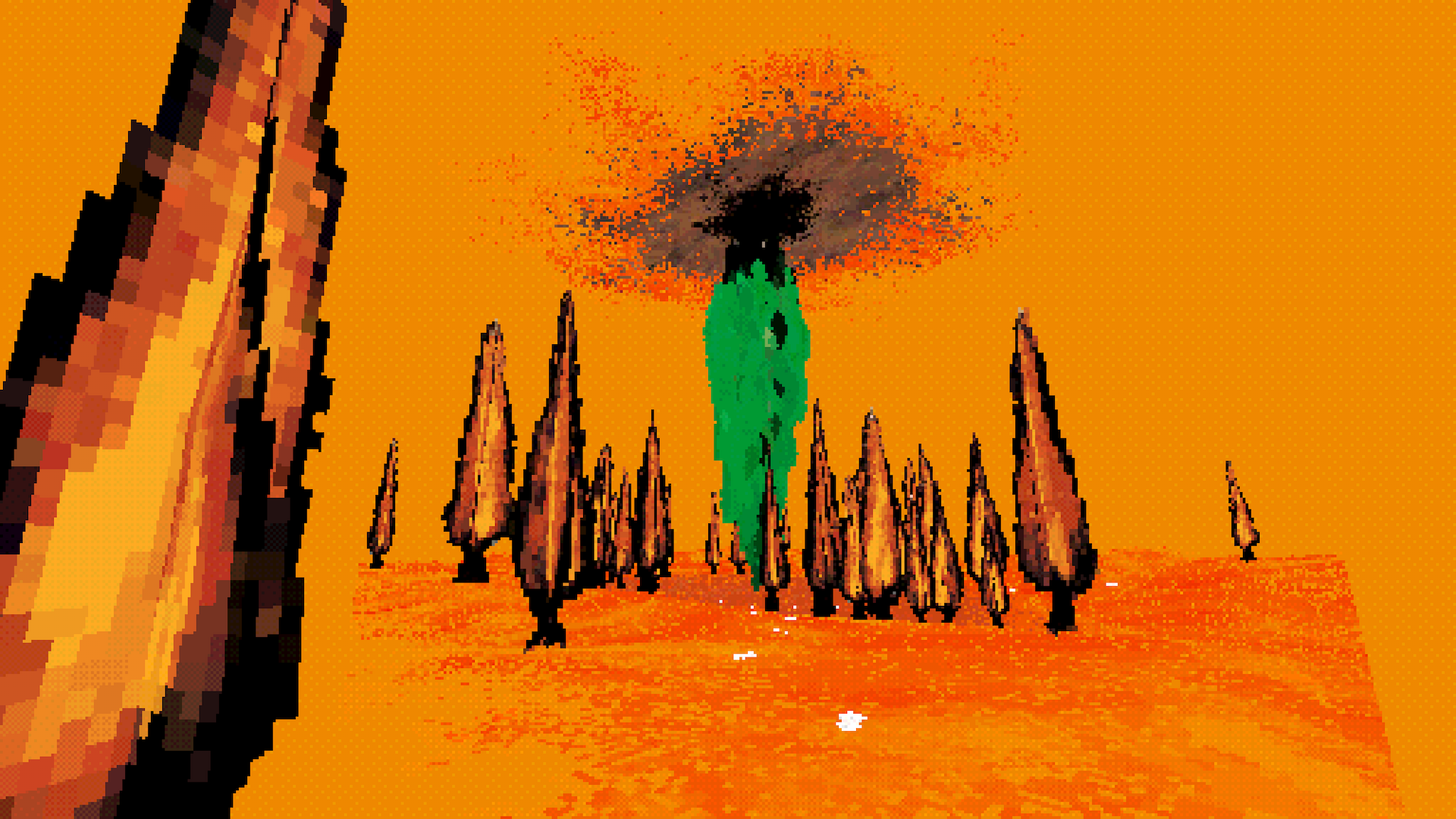
It wasn’t until a year later that this reminiscence bought newfound clarity, with the release of Cuccchi. Developed by Italian multimedia collective Eremo, the game’s development spearheaded by Julián Palacios Gechtman, and a soundtrack crafted by Skinless Lizard, the game has you progressing through abstract levels and dioramas of the artwork of Italian Neo-Expressionist artist Enzo Cucchi.
Self-taught in his work, Cucchi was a part of a larger wave of Neo-Expressionist art in Italy, dubbed “Transavantgarde”, one which sought to escape from the cynicism that grew in the aftermath of World War II. Suddenly, there was a deluge of emotion across the world, and in Cucchi’s case, he toys with culture, and his history, pitting it alongside technological advancement.
In Cuccchi, the game engine is an extension of Enzo’s canvas and context. You explore dioramas crafted of Cucchi’s various works, expanding and revolving while you avoid enemies that can limit the amount of artwork that you can unlock. In its driest sense, it’s a walking simulator. But Gechtmann has, through minor game design elements, invited a new perspective of interaction which “unique” set-ups like Van Gogh Alive fail to create.
I look at Cuccchi, and I see a new universal approach to curate the work of an individual – the interactive experience.
It’s never a theme park, but a reminder of the humanity behind the canvas, or in this instance, a controller. A controller which allows you to give you your own personalized view of Cucchi’s work, free from a frame, and accessible to anybody with that joystick.
I enjoy galleries. The history, always cherry-picked to provide a cohesive narrative, the same way one edits a movie. Just as movies became cinema, video games co-exist on the same plane, without derision, because they also tell tales.
I look at Cuccchi, and I see a new universal approach to curate the work of an individual – the interactive experience. It’s a collaborative effort, between the lifetime of Cucchi’s constant output, the barebones and surreal design of Gechtman’s games, and Skinless Lizard’s skippy and tinned-up soundtrack. A score composed entirely of teenage energy, the drafts saved from years past, free programs and scraps of paper, underlines what Cuccchi is, or at the very least, its ambition.
The result is a diary. A diary of three men’s miles made flesh.
