
Paperboy 2, my favorite early-1990s newspaper delivery/suburban vandalism simulator, wasn’t all madness and delinquency. It also opened avenues for moral uprightness – albeit via slapstick vigilantism of a Three Stooges variety. Your well-placed morning editions could halt runaway baby carriages, or blindside and foil the gunmen who randomly (but frequently) robbed the neighborhood gas stations and convenience stores.
Praiseworthy actions would even grace the next day’s front page. “BOY SAVES BREAKAWAY BABY,” the headline might read, above a photo of your character beaming beside the local police chief. It suggested a hopeful lesson to my younger self: A world that invited casual disregard for others could still notice, and celebrate, heroism.

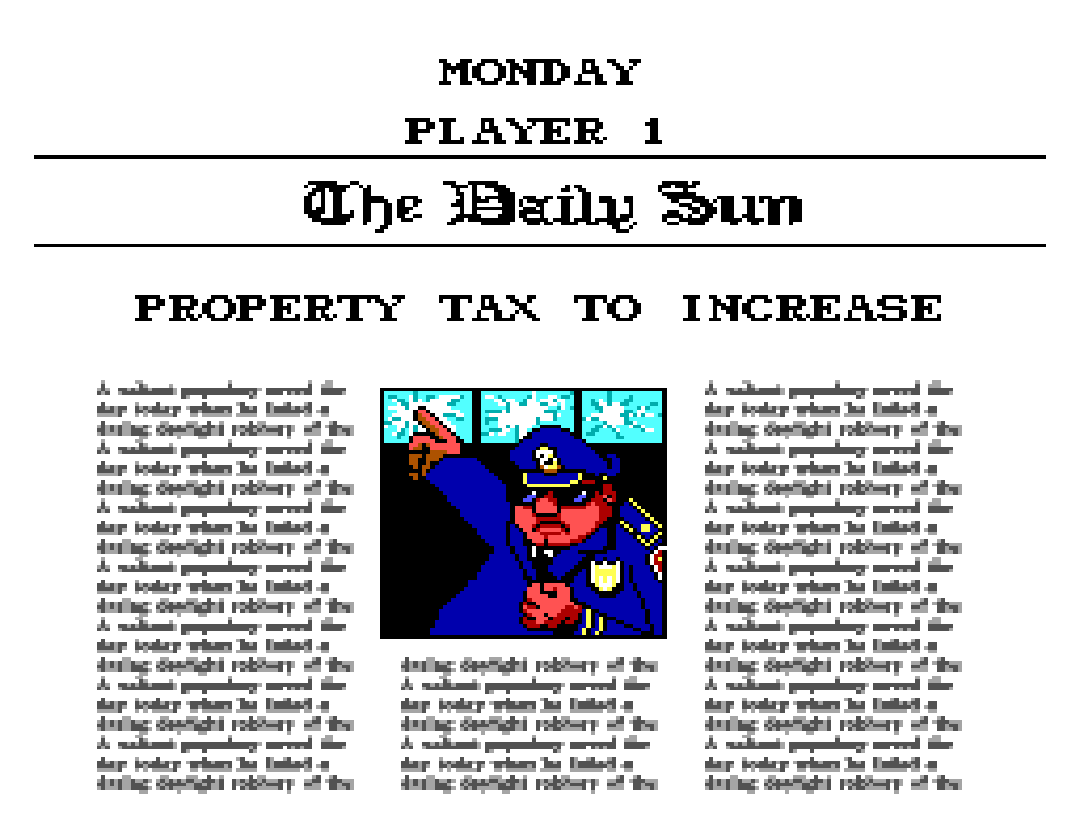
But Paperboy 2 also imparted another, far more acerbic, lesson: Heroism didn’t count if it sacrificed the wrong people’s comforts. Inflicting certain kinds of property damage overrode whatever good you did, prompting the headlines to ignore your potentially lifesaving deeds and emphasize the tragic loss of material possessions or rich-person luxury. “HOSED BATHER FILES COMPLAINT,” the paper reported if a stray newspaper broke a lawn sprinkler, drenching a nearby sunbather. “BROKEN PANES PUZZLE POLICE,” trumpeted another of the game’s many property-centric headlines. The photograph accompanying every such story showed the ubiquitous police chief before a background of broken windows, gesturing as if the busted glass constituted an emergency.
Perhaps this disheartening headline behavior was merely a glitch. But that’s not how it read to me. It sent a clear message: Property had rights. People didn’t.
Paperboy 2 thereby lampooned “Broken Windows Theory” (BWT), a criminology trend in vogue during the game’s heyday. The concept entered the popular imagination following a March 1982 Atlantic article in which the social scientists George L. Kelling and James Q. Wilson proposed that visible property damage signaled the crumbling of social order. Such damage showed where the law’s reach did not extend, thus indicating regions of consequence-free behavior. Disorder therefore begat disorder; crime engendered further crime. In this line of thought, property represented society’s preliminary defense against anarchy. For if damage telegraphed that nothing mattered and all was permissible, then the pristine and manicured did the opposite, asserting that law and order still reigned.
Thanks in part to BWT’s focus on (and tacit championing of) material goods, it became a core tenet of neoliberalism – and neoliberal law enforcement. Failed policies with notably racist legacies, such as “zero tolerance” policing and NYC’s infamous “stop and frisk,” evolved from efforts to put BWT into practice. (Malcolm Gladwell, that perpetual vector of bad ideas, uncritically celebrated BWT policing in his 2000 bestseller, The Tipping Point.) The fallout of BWT endures in the unabated neoliberal obsession with property rights and law-and-order governance, noticeable whenever politicians and media invoke faceless “looters” to discredit protests or broader social movements.
“No window is safe. No fence is too high.”
Paperboy 2 thus represented a small but trenchant critique of neoliberalism and its attendant media apparatus, which prioritize property rights over societal well-being – or basic human decency. Virtually every level opened with the same photograph of the harried police chief and the string of broken windows. The image indelibly linked property damage to runaway crime, while mocking the perpetual state of emergency such paranoid thinking entailed.
Of course, Paperboy 2 had you amplifying that paranoia, either by distributing newspapers that fomented it, or by breaking everything in sight and verifying the papers’ apocalyptic pronouncements. In this latter respect, the protagonist of Paperboy 2 furnished the quintessential Reagan- or Clinton-era yuppie nightmare: A member of the service caste who refused to show their shiny, expensive acquisitions – and the social order those possessions implied – the proper respect. The copy text on the back of the SNES box voiced that otherwise unspoken anxiety: “No window is safe. No fence is too high.” Much like how Halloween’s Michael Myers gave the lie to late-‘70s suburbia’s foundational myths of safety and security, the paperkid existed to upend a new era of suburbanite peace of mind.
Nowadays, Paperboy 2’s resonance lies less in its merry Simpsons-level cynicism and proto-Grand Theft Auto antics than its lingering questions regarding the world it satirizes. The late Seth Flynn Barkan’s poem about the original Paperboy hints at this uncertainty:
if only I could save you
from the blondes in the black
Duesenbergs; hold you back,
grab your fucking handle-bars,
shaking my head, preventing
your insane ride into traffic
saying “it’s not worth it, kid;
whatever they’re paying you, it’s not worth it.” (1)
One suspects that the “it’s not worth it” refrain is a facile joke regarding the paperboy’s disproportionately hazardous job and meager paycheck. Yet perhaps the sentiment isn’t really a warning about the paper route’s dangers and pittance recompense. In Paperboy 2’s wake, it lands instead as an admonition against serving a society that has forgotten how, and what, to value.
(1) Barkan, Seth “Fingers” Flynn. “Paperboy.” Blue Wizard Is About to Die: Prose, Poems, and Emoto-Versatronic Expressionist Pieces About Video Games, 1980-2003. Las Vegas, NV: Rusty Immelman Press, 2004. 24.
